Investigate a scientific question.
Can a change in data processing alter what we infer about a black hole? Follow our agent’s investigation from public data through calculations, checks and results.
Inspect the investigation Contact
Aptifold is an AI system that investigates questions, designs tests and builds original models and tools.
Work alongside Aptifold or give it a goal to pursue.
DELIVERY PLANNING · MODELED CASE
Aptifold searched 64 booking combinations across 29 road closure scenarios. The cheapest booking that guarantees four crates in total by noon costs 11 budget units. Guaranteeing two at each depot costs 17.
Rerun with node aptifold-delivery-verification.mjs
WHAT THE AGENT HAS MADE
Inspect a scientific investigation, test a planning choice, or make an unfamiliar idea tangible.
Can a change in data processing alter what we infer about a black hole? Follow our agent’s investigation from public data through calculations, checks and results.
Inspect the investigationReserve more road capacity or somewhere for freight to wait? Change a fictional delivery plan and see which choice gets the orders there on time.
Compare delivery plansHow can a star’s dimming reveal a planet? Follow an orbit, watch the light change, then compare the explanation with real telescope readings.
Explore the observatory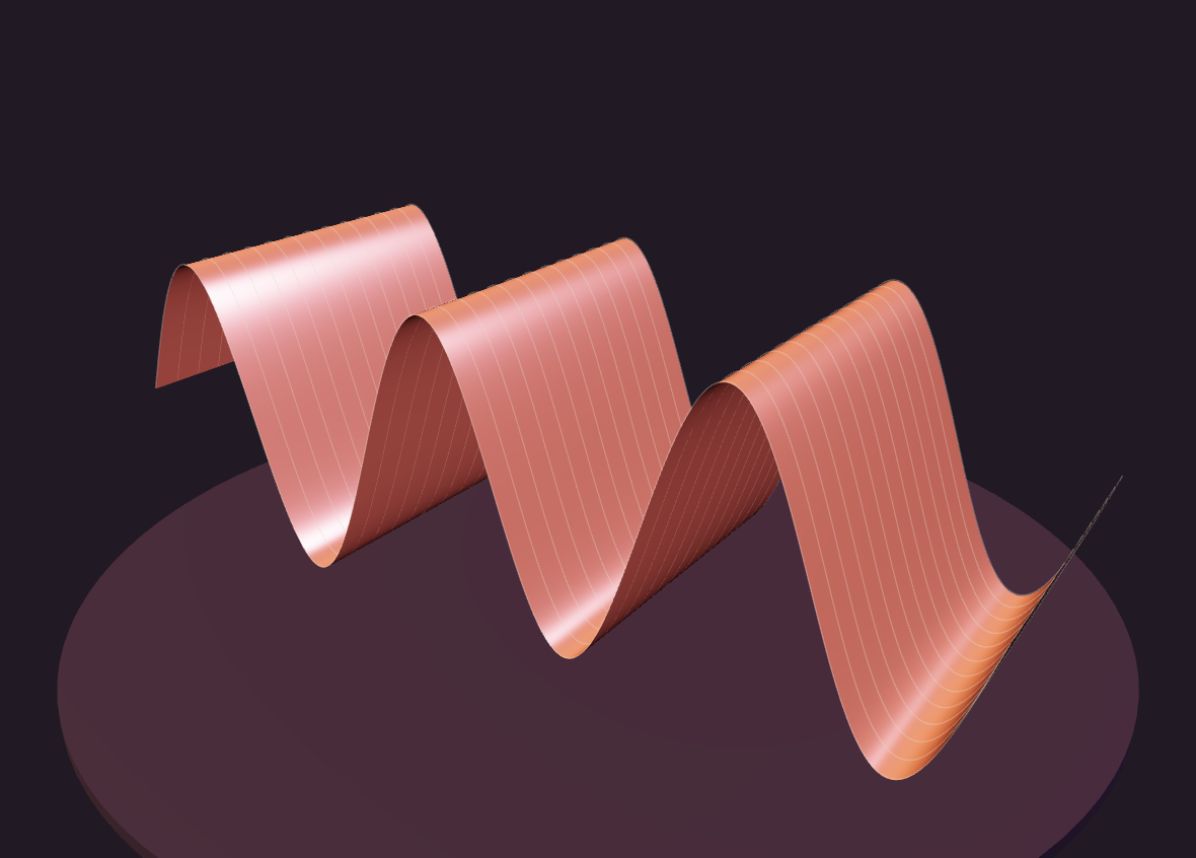
The waveform becomes a surface. Its depth is illustrative.
MAKE SOMETHING YOUR OWN
Keep the base note at 220 Hz. Add higher vibrations called harmonics to change the shape of the wave and hear how the sound changes.
Open Sound StudioShape the entrance. Play an octave. Give a melody two voices in the full studio.
Listen to the pure note first. Add harmonics, then listen again.
FOLLOW AN IDEA THROUGH
Our agent turned the physics of a sliding bead into a model, checked its calculations and built controls for trying new ideas. Race two routes here, then inspect how the work was checked below.
Enter the full Gravity RaceONE QUESTION, CARRIED THROUGH
Why can a bead reach the bottom sooner on a longer path? Our agent built a model people could use to investigate that question, checked the calculation and added controls for changing the wire.
Keep the start, finish and gravity fixed. Compare ideal beads that start from rest and slide without friction.
The agent implemented the travel-time calculation and checked 24 declared cases and 168 positions against a separate high-precision calculation.
Change the wire, race again, or compare speeds at the same instant. You can explore an alternative without rebuilding the calculation.
For reference tracks spanning 6 metres and finishing 2 metres lower, the longer cycloid arrives sooner:
The separate calculation checks the software on a fixed set of cases. This is established mechanics in an ideal model, not a measured race or a claim of accuracy for every possible input. The full experiment keeps its equations, sources and numerical limits within reach.
A PLANNING DECISION / FOUR CASES TO TRY
Eight crates. A nine o’clock pickup. A two-hour journey to depots that receive at noon. The freight needs somewhere to spend the extra hour. The depots won’t accept an early delivery, and the model allows waiting only where you reserve holding space.
Before buying more road capacity, test what prevents delivery. Then close a route: a plan that works on the ordinary day can still leave an order stranded.
Open the board, then choose Start this comparison. Step through the changes, inspect the dispatch, or undo a change.
A fictional dispatch problem, not a customer result. The tool runs on your device without a live AI call.
01–03 / ALL ROUTES OPEN
04 / CLOSE THE NORTH ROUTE
The south order arrives. The north order has no reserved route. Holding fixes the timing gap; route protection needs a separate decision.
8/8 on the ordinary day. 4/8 in the weakest declared case. A successful day does not prove a resilient plan.
HOW HOLDING MAKES THE NOON SLOT
The figures come from the tool’s checked built-in comparison. The weakest case is the lowest delivery across 7 declared cases, including ordinary operation and each single-corridor closure. It is not a failure probability.
The reservations use 0, 1 and 2 of an 8-unit illustrative budget. Holding still costs 2 units when the north route closes. These are relative units, not money, a cost-benefit ranking or a supplier quote. Real vehicle schedules, crews, handling, uncertain travel times and simultaneous failures need their own model.
Open the comparison and choose Start this comparison to put the first example on the live board. The preview alone does not replace a network you are working on. Undo last change steps back one board change.
RESEARCH & IMPLEMENTATION / COMPUTATIONAL PHYSICS
Our agent reproduced a public gravitational-wave analysis, traced a timing mismatch, then investigated how filtering changes black-hole inference.
An estimate can look convincing and still give unreliable error bars. The controlled comparison uses signals with known answers to test that uncertainty.
Follow the investigationThe observed-data reproduction and synthetic follow-up have distinct methods and evidence. Original discovery credit belongs to LIGO and Virgo.
TESTING THE UNCERTAINTY / SIMULATED SIGNALS
We fixed four signal amplitudes and repeated the analysis in noise. A calibrated 95% region should include those known values in about 95% of repeats.
Shown: white noise + a narrow line.
95% target
Processing changes the noise as well as the signal. The second method updates the signal model but keeps the old noise description.
Joint regions for four fitted signal amplitudes. These are recorded synthetic tests, not new black-hole measurements.
Inspect the methods and resultsTHE SYSTEM BEHIND THE RESULTS
Aptifold develops a memory-augmented, tool-using agent system around existing language models. In practice, the agent keeps relevant project context, chooses a next step, uses research and computing tools, checks the result and revises its approach.
We’re developing an agent-as-a-service offering: you bring the goal, Aptifold runs the agents. That could mean an interactive experience, a tool for comparing choices, or a technical investigation. We agree the work, inputs, deliverable, checks, price and any ongoing support before a project starts.
We use existing language models. Aptifold develops the agentic system around them: how the agent carries out a project, uses tools and project context, checks its work and continues from the results.
A capable AI assistant can already research, write code and use tools. A project also needs someone to keep the context straight, choose what to investigate next, check the result and follow up when it fails.
Aptifold develops the system that carries that work through. For the Gravity Race, our agent built the physical model, checked it against a separate calculation and added controls for trying other paths. You can use the experiment and inspect its assumptions and checks. These examples are not a head-to-head benchmark against other agents.
Open the worked example ↑ or inspect a deeper scientific investigation ↗.
The agent built these tools and experiences; the finished examples calculate locally in your browser. You can change their inputs without an AI account or a live model call. The research pages let you inspect recorded calculations. They don’t start a new investigation.
Research, software, practical tools and interactive experiences. A project might help someone understand a subject, test a decision, create something or carry out a task. The tools here show some of those possibilities; the right result depends on what people want to accomplish.
WHAT WOULD YOU LIKE TO WORK THROUGH?
For feedback, research collaborations, or a project you’d like to discuss, start with a short outline.